
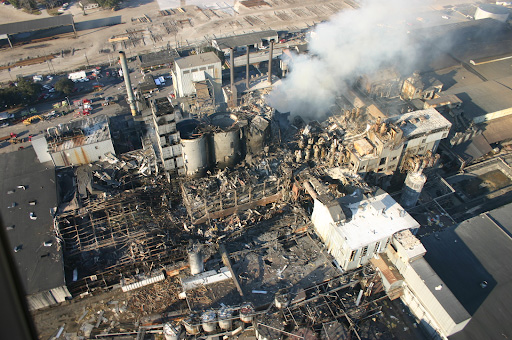
 In most facilities, air movement equipment runs quietly in the background—until something goes wrong. And when the airstream involves combustible dust, vapors, or fine particulates, the stakes change. A single spark inside a fan or duct path isn’t just a nuisance. It’s an ignition source. And that can end in an incident that nobody wants tied to their plant.
This is why spark-resistant designs exist. Not as an upgrade, not as a “nice to have,” but as a guardrail for operations where the consequences of an internal strike are severe.
Where Sparks Come From (and Why They Form Without Warning)
Inside any fan, you have rotating metal, bearings, hardware, and sometimes worn surfaces. With standard construction, sparks can form from:
- A blade rubbing the housing because of vibration or a loosened fastener
- Foreign debris getting pulled into the fan
- A bent wheel after years of service
- Corrosion that changes clearances over time
None of these failures announce themselves ahead of time. They are silent, cumulative, and invisible until the moment friction turns into a strike.
In a clean-air application, that spark might mean nothing. In the wrong environment, it can light off a chain reaction.
When the Risk Crosses the Line
Spark-resistant construction becomes mission-critical in operations where the airstream may include:
- Metal grinding, magnesium, or wood dust
- Solvent vapors or resin fumes
- Fine powder from food ingredients
- Paint booth exhaust
- Flammable plastics, fibers, or particulates
Even if these materials enter the airstream only occasionally, the hazard still exists. Most dust explosion incidents don’t come from constant exposure—they come from a single abnormal condition aligning with a moment of spark.
That’s why engineers and safety leaders specify spark-resistant fans in three common scenarios:
1. When the process can’t guarantee clean air
If your line produces dust intermittently—during start-ups, bag changes, or material transfers—you cannot rely on a “clean-air only” assumption.
2. When vibration and wear are unavoidable
High duty cycles, corrosion, or temperature swings make mechanical drift more likely. As clearances tighten or components fatigue, spark risk rises.
3. When a single incident carries outsized consequences
Some plants simply cannot risk an ignition event: automotive paint lines, chemical processing, food plants with combustible dust, and any facility with enclosed conveying of fine material.
In these settings, spark-resistant construction isn’t about adding a feature. It’s about removing a potential failure mode.
What Spark-Resistant Construction Actually Does
There’s a misconception that “spark-resistant” means “spark-proof.” That’s not accurate. What these designs do is reduce the chance that metal-to-metal contact can create a hot strike. Depending on the class, this can mean:
- Nonferrous materials on the inlet cone
- A nonferrous rubbing ring
- Aluminum or bronze protection on rotating components
- A design that prevents direct metal impact
The purpose is simple: if something goes wrong inside the fan, the internal geometry doesn’t turn the failure into an ignition point.
It’s a control step—just like grounding, bonding, and dust collection—meant to stop a small mechanical issue from becoming an emergency.
A Preventive Measure Many Plants Ignore
Ask most maintenance managers why they didn’t specify spark-resistant construction, and you’ll hear the same answers:
- “We’ve never had a problem.”
- “It’s a clean application.”
- “The old fan didn’t have it.”
But these assumptions overlook what actually causes most incidents: not the routine conditions, but the unusual ones.
If debris falls into the airstream once every three years, that’s enough.
If a fan drifts out of alignment after years of vibration, that’s enough.
If a tiny amount of combustible particulate enters during a single process upset, that’s enough.
Every facility that handles flammable dust or vapors has a simple choice:
Do you want mechanical drift to be a maintenance event…or an ignition event?
How Leaders Think About Spark Resistance
Engineering teams that treat spark-resistant construction as non-optional tend to follow a few principles:
- Assume drift — every mechanical system changes over time.
- Plan for debris — even well-maintained plants have foreign material enter equipment.
- Focus on “rare but real” risks — not just daily operations.
- Match the design to the hazard, not the budget line.
These are the same mindsets behind lockout/tagout, grounding, and bonding. None of those are optional either.
Ready to Reduce Risk in Your Air Movement System?
If your process involves combustible dust, vapors, or any condition where an internal strike could trigger an incident, Air Systems can help you evaluate the right level of spark protection. Our team works with plant engineers daily to match construction types to real-world hazards—not assumptions.
Contact Air Systems to ensure your next fan is built with safety in mind.